Building local systems for child nutrition in Nepal
Earlier this year, Jwalamukhi Rural Municipality in Nepal's Dhading district was declared the country's first Model Clean and Hygienic Rural Municipality. What has happened since matters more than the title: the municipality has spent the months following it building the systems that make the recognition mean something — an endorsed guideline, a growth card in families' hands, equipped health posts, a named focal person, and a line in its own budget.
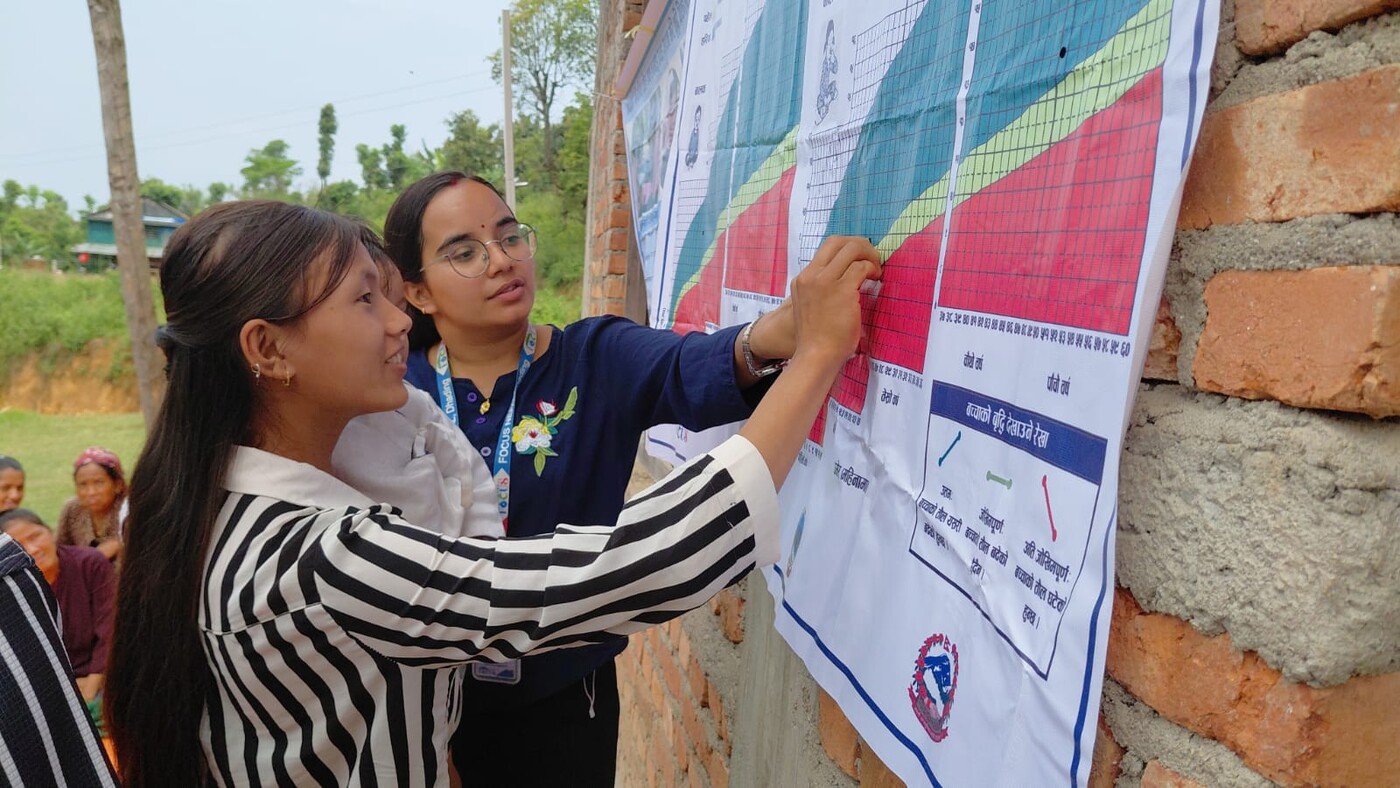
Community mobilisers mark a child’s growth on the chart during a courtyard session in Ward 4, Jwalamukhi Rural Municipality.
Max Swastha Palika is the Nepali adaptation of the Healthy Village approach, running in Jwalamukhi since October 2025 with FOCUS Nepal as implementing partner and technical support from Max Foundation Bangladesh. It brings water, sanitation and hygiene (WASH), nutrition, and maternal and adolescent health together in one approach, with local enterprises supplying the products and services families need. The same model halved child stunting in three years in Bangladesh and Ethiopia. Jwalamukhi is home to 21,338 people across 6,079 households and seven wards.
Much of the work runs through Nepal’s own smallest unit of community organisation. Each neighbourhood, or tole, has a neighbourhood development committee — a Tole Bikas Sanstha — made up of residents who plan and oversee local priorities. Jwalamukhi has 100 of them, and they are where decisions about water, sanitation and child health are actually taken.
A guideline, a card, and a budget line
The Child Growth Monitoring Guideline was developed with Jwalamukhi’s health section and the Dhading district health office, against national and World Health Organization standards, and formally endorsed by the municipal executive this spring. The Growth Monitoring and Promotion (GMP) Card that goes with it — an eight-page booklet families keep at home — was inaugurated by the municipal Chairperson. Health posts across the municipality now hold height boards, weighing scales, infantometers and stadiometers.
Jwalamukhi has also appointed its Public Health Officer as dedicated focal person for the programme, and at its annual planning and budgeting workshop committed roughly NPR 800,000 (approximately €5,000) to Max Swastha Palika activities in the coming fiscal year, to be carried in the municipal Red Book. Less than a year into a four-year programme, the municipality is already co-financing it.
Where the systems now reach
662
children under five measured for height, weight and mid-upper arm circumference
166
courtyard groups, covering all 100 neighbourhood development committees
36
Female Community Health Volunteers trained on measurement and referral
29
entrepreneurs selected through an open municipal call, 19 of them women
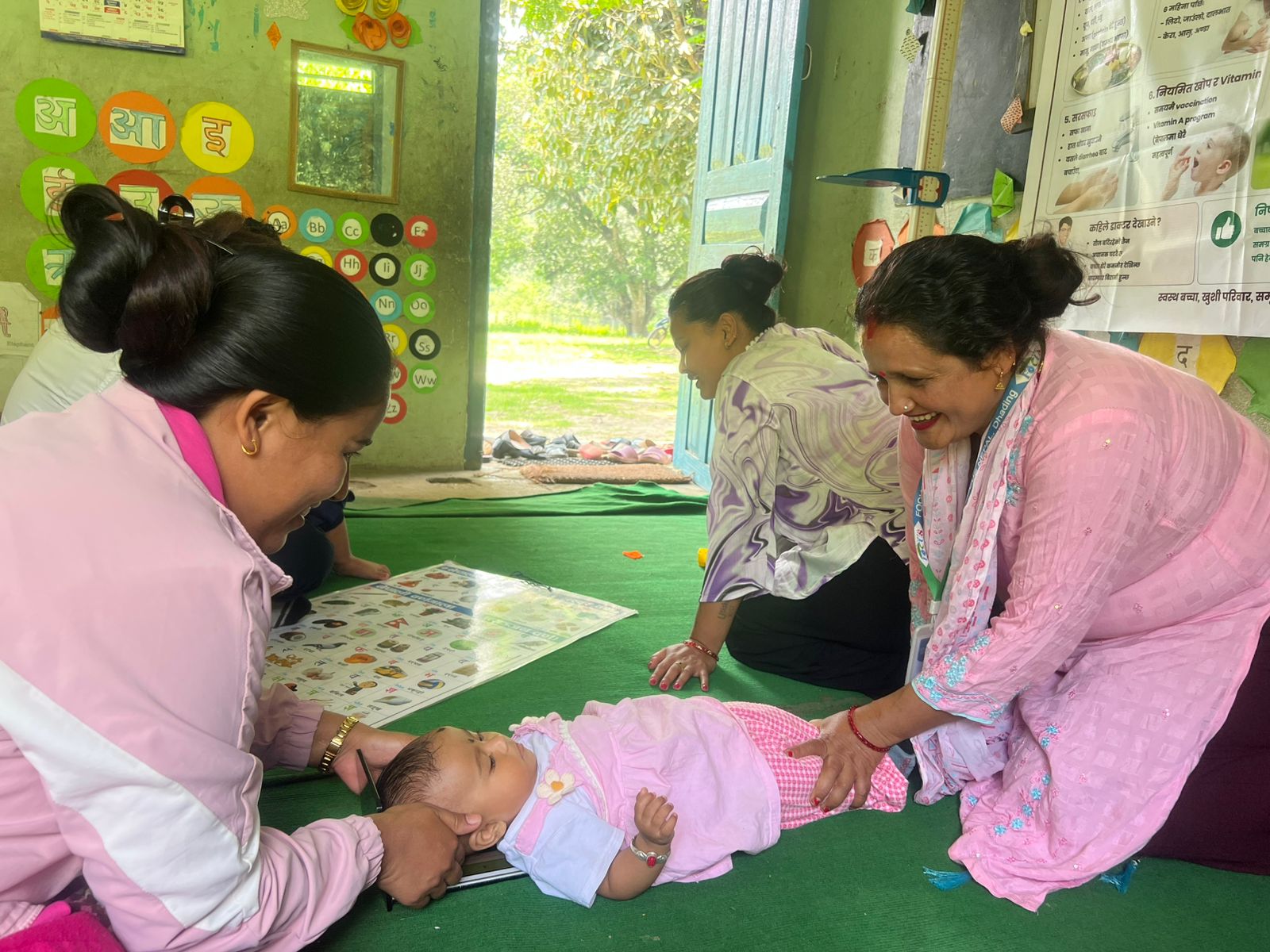
A community mobiliser measures the length of an infant during Nepal’s National Nutrition Assessment Campaign.
Measuring children where families already are
Growth monitoring in Jwalamukhi is not a parallel activity. During Nepal’s National Nutrition Assessment Campaign, community mobilisers worked alongside municipal health facilitators and health post staff to measure 662 children under five, and the work now runs through routine immunisation clinics and primary health care outreach. Nearly 800 mothers from all seven wards took part in sessions on why regular measurement matters.
Thirty-six Female Community Health Volunteers trained across four health posts — Maidi, Dhola, Salbas and Khari — on measuring accurately, using the GMP Card, and referring children who need treatment. Alongside them, 166 courtyard groups now cover every one of the municipality’s 100 neighbourhood development committees. Sessions on child growth have reached 146 of those groups and 86 committees, involving around 1,356 mothers, caregivers and neighbours.
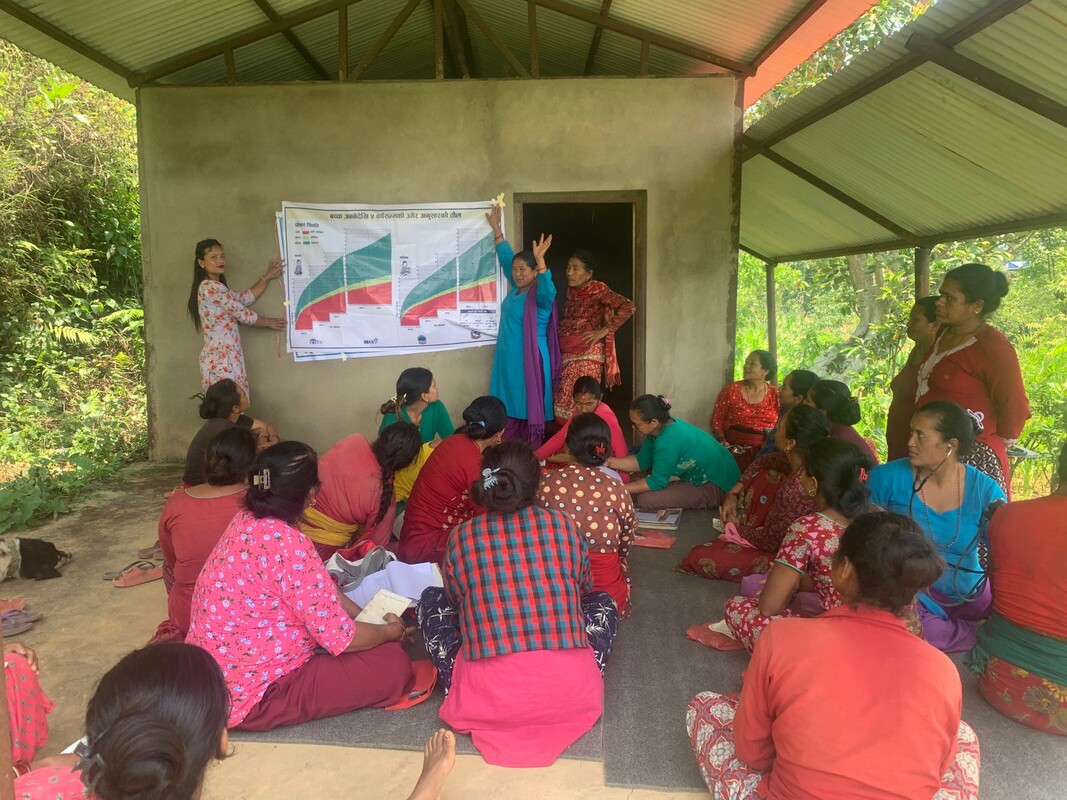
A courtyard session on child growth at Maidi, supported by health post staff.
These groups surface problems that a survey would miss. In Ward 6, thirteen sessions on treating water at low cost drew 264 participants and produced a specific insight from the people in the room: households that treat water at home still drink untreated groundwater while working in the fields. The response — carrying treated water out with you — came from the same conversation. Twenty-two schools have completed a WASH review, eleven of them including menstrual hygiene management.
A market that outlasts the programme
Awareness only holds if families can buy what they need nearby. A municipal selection committee ran an open call and received 40 applications; 29 entrepreneurs were selected — 19 women entrepreneurs, five Sani Mart operators and five cleaning service providers. Twenty-eight have since completed four days of training in Dhading on business planning, marketing and generating demand for WASH and nutrition products. Running the selection through a municipal committee rather than the programme was deliberate: it puts the decision, and the accountability for it, with the local government.
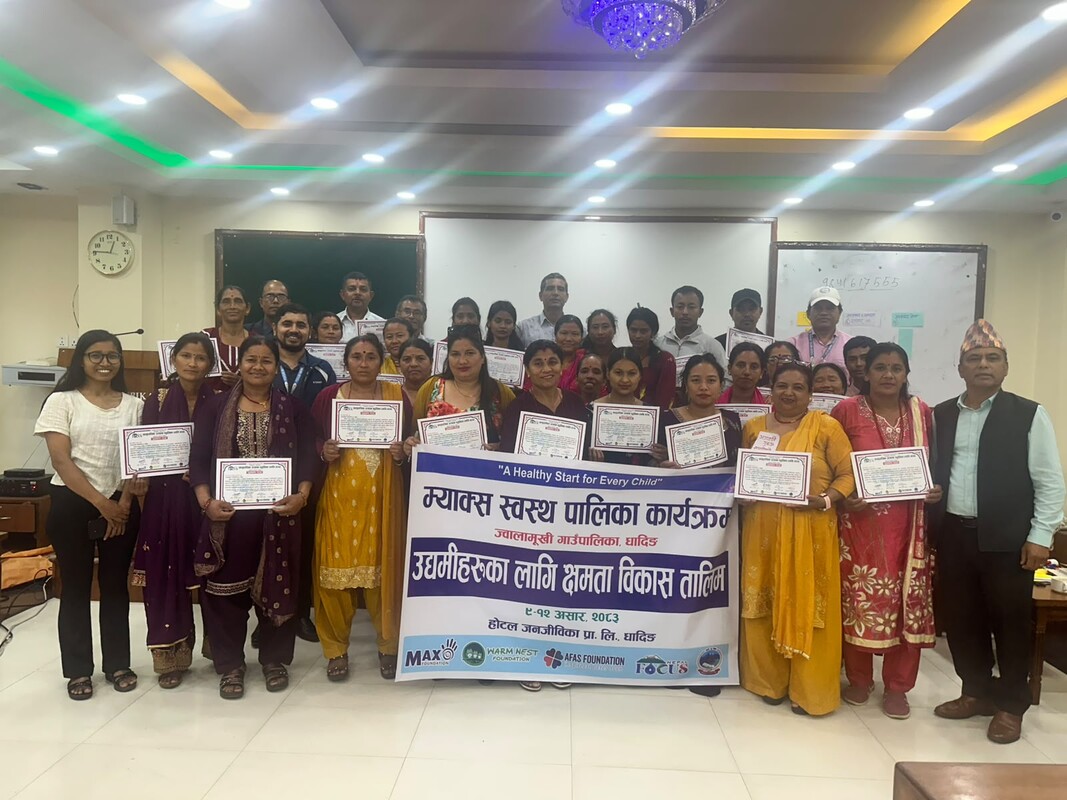
Entrepreneurs from Jwalamukhi with their certificates after four days of business training in Dhading.
What we are learning so far
Not everything has moved at the pace originally planned, and the reasons are as instructive as the progress. Declaring individual neighbourhoods as Swastha Palika has been carried forward: the tenure of the existing neighbourhood development committees has lapsed and the municipality is reconstituting them. The declaration only means something if those committees are in place to stand behind it, so it waits.
Building a single digital platform for participatory monitoring has proved more technically complex than expected, so it is being phased in with a simpler interim system tracking data meanwhile. Training for health workers on growth monitoring was deliberately held back while the team reviewed the government’s own training manual and referral practice for stunting cases — better to align with national protocol than to move quickly and teach something that runs parallel to it. Monsoon season and the close of the fiscal year slowed the pace further.
None of this is unusual in the first year of working through government systems, and being clear about it matters. An approach that only reports what went well is difficult for anyone else to learn from.
A national conversation about replication
In Kathmandu a few months ago, 28 representatives from the National Health Education, Information and Communication Centre, the World Health Organization, the Bagmati Province Health Directorate, the Epidemiology and Disease Control Division, the Dhading public health office and Dhulikhel Hospital reviewed Jwalamukhi’s Healthy Jwalamukhi Strategy Plan and discussed what replicating the approach elsewhere in Nepal would require, from policy integration to financing. The same meeting gathered technical feedback on the GMP Card’s height chart and colour-coding.
This is the kind of scaling we most want to see. Not a model exported intact from one municipality to the next, but other governments looking closely at what has worked in Jwalamukhi and what has not, and deciding for themselves what to carry into their own context and what to do differently. A programme that ends when the funding ends has not changed much. Systems that can read the evidence and adapt it themselves are what lasts.
Max Swastha Palika runs in Jwalamukhi Rural Municipality until 2029, with the aim of reducing preventable water- and faecal-borne disease and improving child nutrition through an approach the municipality itself leads. It is delivered with FOCUS Nepal and supported by AFAS Foundation and Warm Nest Foundation.