Piloting Innovative Public-Private Water Service Models
Bangladesh · Water
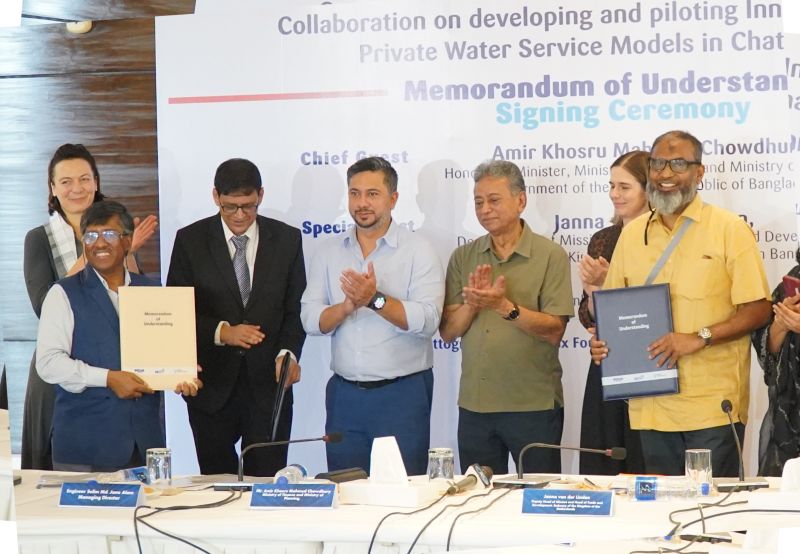
Chattogram Water Supply and Sewerage Authority (CWASA), Max Foundation Bangladesh and Max Social Enterprise Ltd. (Max TapWater) have signed a Memorandum of Understanding to jointly explore public–private water service models for Chattogram. The work begins with a needs assessment and pilot in Wards 40 and 41 — North and South Patenga — where around 164,000 people have gone four decades without reliable access to safe drinking water.
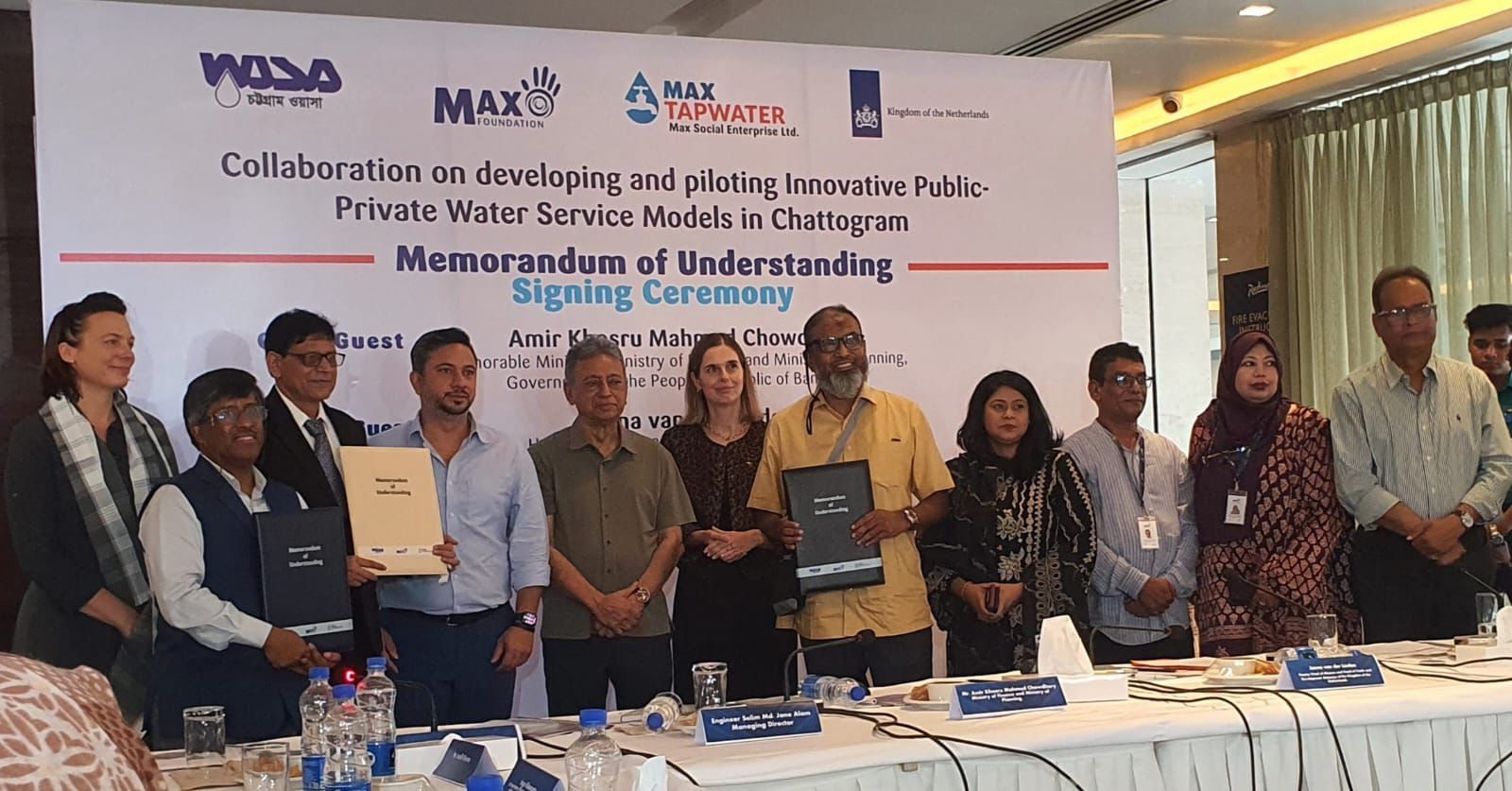
The agreement was signed on 4 September 2026 in Chattogram, in the presence of Amir Khosru Mahmud Chowdhury, MP, Minister of Finance and Planning, and Janna van der Linden, Deputy Head of Mission at the Embassy of the Kingdom of the Netherlands in Bangladesh. The Embassy is not a party to the MoU; it witnessed the signing and provides financial and technical support to the initiative.
A rapid assessment carried out by Max Foundation Bangladesh and Max Social Enterprise Ltd. in May 2026, with strong participation from local ward representatives, mapped household demand, water quality and the informal vendor market across the two wards. It found that CWASA’s piped network reaches only 20–40% of households. Most residents buy water daily from private vendors — between 85 and 115 of them operate across the two wards — paying BDT 25 to 50 in cash for 25 to 30 litres, and as much as BDT 5,000 a month in the worst-served pockets. That spending buys volume, but no assured quality standard, no regulated tariff and no service anyone is accountable for.
Over the coming months the parties will run a structured needs assessment covering technical, financial, legal and social conditions, and discuss a bulk water contribution from CWASA. The assessment will shape the design of a pilot in Wards 40 and 41, which in turn feeds a pre-feasibility study for a possible larger public–private partnership in Chattogram. No tariff, price or launch date has been set — the assessment will determine those.
- CWASA remains the formal authority and regulator, retaining ownership of public water assets, tariff-setting authority and oversight of water quality and service standards.
- Max Foundation Bangladesh coordinates the partnership and stakeholder engagement, facilitates the assessment and feasibility work, and documents the evidence as a public resource.
- Max Social Enterprise Ltd. (Max TapWater) leads technical design, implementation and operation of the pilot, including a financially sustainable service and tariff model, local entrepreneurship development and IoT-enabled monitoring and billing.
The three parties will also work towards a Centre of Excellence in drinking water solutions, so that what is learned in Patenga is available to others. The MoU runs for three years from signature, is renewable, and is explicitly non-binding in legal and financial terms.
Public utilities hold the mandate, the bulk supply and the infrastructure. Private operators bring commercial discipline, maintenance capacity and the incentive to keep water flowing every day. Neither alone has closed the gap in Chattogram’s underserved wards. This collaboration tests how the two can work together under public oversight — with an NGO as a neutral facilitator and learning partner, building the evidence that makes such a model investable and repeatable.
It is a new direction for us. Under the Building Water Business programme (2022–2026), funded by the Embassy of the Kingdom of the Netherlands, more than 105 decentralised water grids now operate across Patuakhali, Barishal and Khulna, serving over 16,000 customers daily with a tariff-collection rate above 90%. Those grids are stand-alone and community-managed. This MoU is our first formal collaboration with a public water utility.
“This is very much in line with our broader economic policy of building a creative economy and ensuring last-mile connectivity. The government alone cannot always reach the last mile. NGOs have the outreach, the private sector brings experience, finance and investment, while the government provides facilitation. These three forces must work together, and I am glad this project is based on that principle.”
Honourable Minister Amir Khosru Mahmud Chowdhury, Ministry of Finance and Ministry of Planning, Government of the People’s Republic of Bangladesh
“Our relationship is evolving. We are moving away from a traditional focus on aid and development towards creating an equal partnership based on sustainable economic development. This means combining development impact with sustainable business models, innovation and private investment. And Chittagong is where we want to do this.”
Janna van der Linden, Deputy Head of Mission, Embassy of the Kingdom of the Netherlands in Bangladesh
Engineer Selim Md. Jane Alam, Managing Director of CWASA, said the partnership among the three entities is setting a benchmark for urban water management — one where public regulation and private innovation work hand in hand to serve the people of Chattogram reliably and sustainably.
Dr. ATM Tariqul Islam, Country Director of Max Foundation Bangladesh and Nepal, used the occasion to call for policy alignment behind water sector public–private partnerships, and invited local enterprises and private investors to bring operational rigour, technology and co-investment into community water service delivery.
Chattogram produces around 400 million litres of water a day, yet roughly 1.2 million residents remain outside household piped coverage, with a citywide daily demand gap of about 70 million litres. If the Wards 40 and 41 pilot and the pre-feasibility study prove viable, they are intended to create a template that could inform public–private service models in other Bangladeshi cities facing similar gaps. Any decision on a larger partnership rests with CWASA and the Government of Bangladesh under the Public–Private Partnership Act 2015.
The signing was covered by national and local media in Bangladesh, reflecting wider interest in how public–private models might close the country’s urban water gap.
The Daily Star — Over 164,000 Chattogram residents targeted in new safe water initiative
The Financial Express — CWASA joins hands with Max Foundation, Max Social Enterprise
Daily Waadaa — New model underway to resolve Ctg water crisis