A community meeting on local budgets in Pyarpur, Bangladesh.
In coastal Bangladesh, a digital tool lets communities and councils follow every taka allocated to child nutrition and clean water. Local government now funds it from its own budgets, and national policy is absorbing it — a tool built with communities, carried forward by the system.
Budgets behind closed doors
In Bangladesh, the most local budget decisions are made by Union Parishads — elected councils that form the lowest tier of government. Each Union Parishad covers nine wards, and councils are required to consult these wards before setting their annual budget. In practice, however, many councils lacked the systems to show how money was actually spent, and communities had few ways to check whether commitments to nutrition or to water, sanitation and hygiene (WASH) services were followed through. Services that shape a child’s first years — safe water points, hygienic latrines, growth monitoring at community clinics — all depended on budget lines that few people could see.
A tool that opens the books
Working with local government and civil society, Max Foundation and its partners introduced the Budget Monitoring and Expenditure Tracking (BMET) tool: a web-based application, developed with the Horizontal Learning Programme (HLP) Foundation and building on the budget-advocacy expertise of the Centre for Economic Governance and Accountability in Africa (CEGAA). It displays Union Parishad budget allocations and real-time expenditure on nutrition and WASH in an open, online environment — embedding transparency into the council’s routine planning, budgeting and monitoring rather than running a parallel process alongside it.
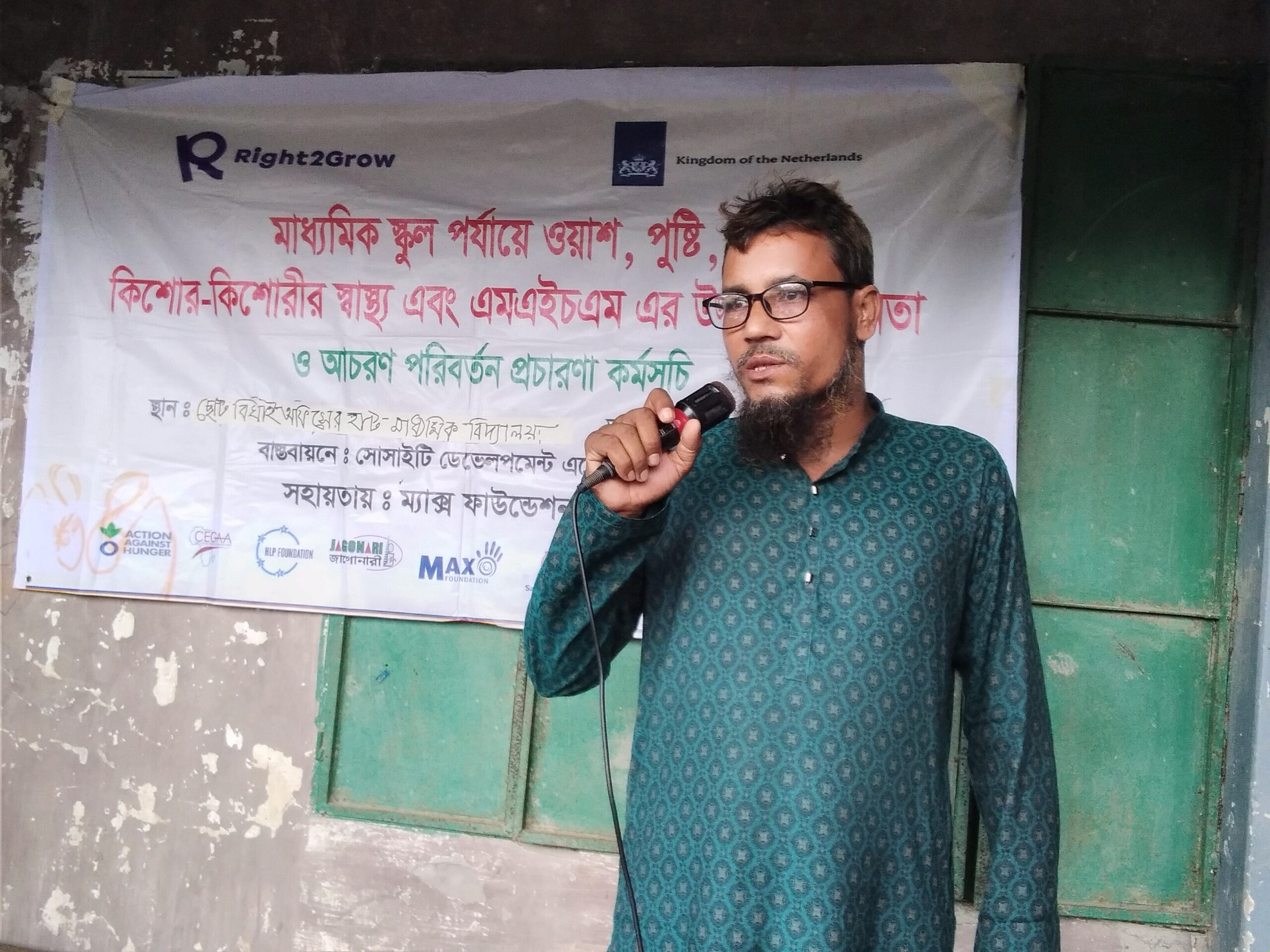
Council officials and CSOs can both see the same figures. That shared visibility changes the conversation: instead of debating whether money was spent, communities and councils can discuss how it was spent, and what should come next. With training and support, civil society organisation (CSO) members bring their communities’ priorities to ward consultations and budget hearings, and use the tool to follow up on what was agreed — people like Bashir Uddin Gharami, the local doctor of Pyarpur village and elected General Secretary of his community’s CSO.
“
I have been able to raise my voice in the presence of the Union Parishad Chairman and government officials to demand budget for addressing required WASH-Nutrition & Child health services of my own community. This way we, the CSO members, are jointly working to raise our voices for the rights of the children under five.
Bashir Uddin Gharami — General Secretary of a CSO in Pyarpur village, Chotto Bighai Union
What changed
By 2025, all 40 participating Union Parishads were using the BMET tool and had integrated nutrition and WASH priorities into their Annual Development Plans.
Union Parishads using the BMET tool for budgeting and planning
Share of council budgets for child nutrition and clean water, 2021–2025
Improvement in expenditure efficiency after BMET data prompted mid-year reviews
WASH expenditure against allocation in Dumuria Upazila, FY 2024–2025
The data does more than describe; it drives decisions. When BMET figures showed gaps between budgeted and actual expenditure, CSOs and councils introduced mid-year dialogues to review progress. In Dumuria Upazila in Khulna division, WASH expenditure across 14 Union Parishads exceeded the original allocation in the 2024–2025 fiscal year, as councils responded to community advocacy.
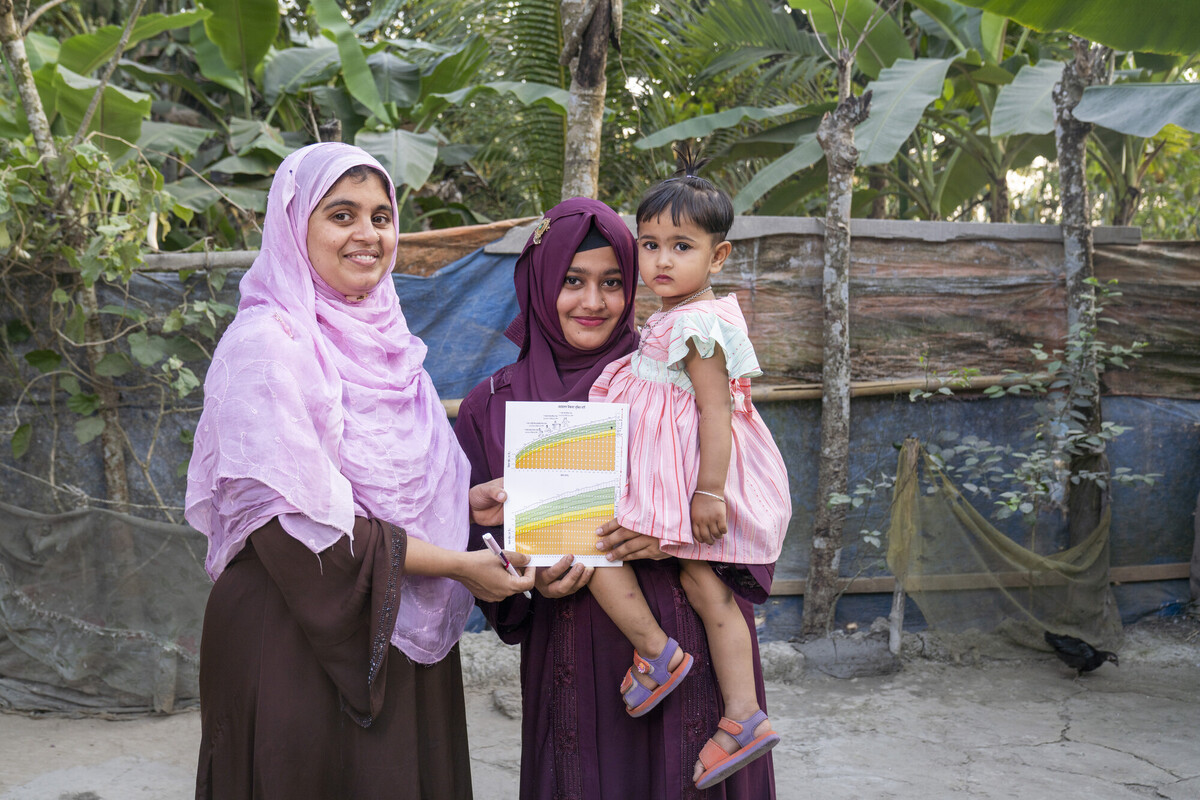
These are not abstract figures. Budgets shaped by community priorities have paid for growth measurement equipment and micronutrient supplies at community clinics, hygienic latrines, safe water points, and subsidised transport so pregnant women in remote areas can attend antenatal care.
From community tool to government system
The headline of this story is not the tool itself, but what government has done with it. In May 2025, seven Union Parishads — Dhamalia, Raghunathpur, Rudaghara, Maguraghona, Bhandarpara, Magurkhali and Dumuria — allocated their own funds to maintain the tool, making it a line in their regular budgets rather than an externally supported extra. Upazila (sub-district) and district authorities have formally recognised the approach, and the Local Government Division has committed to expanding its use to additional sub-districts.
National institutions are taking it further. The Bangladesh National Nutrition Council has recognised both the BMET tool and its companion, the Child Profile Estimation and Costing Model — which estimates how many children need services and what reaching them will cost — for national use, with the costing model being integrated into the country’s Third National Plan of Action for Nutrition.
Silindile Shezi of CEGAA, who has supported budget advocacy across a dozen countries, has seen what follows when governments take this on: “When there’s public participation, there’s a big opportunity for improved accountability.”
Why this matters
Max Foundation does not measure impact by activities delivered during a programme period, but by what remains functional in the system afterwards. By that measure, BMET in Bangladesh is a result we value highly: a tool co-created with communities and councils that local government now funds, district administrations formally recognise, and national nutrition policy is absorbing. Our role was that of catalyst and integrator — the budgets, the decisions and the accountability belong to the public system, where they should.
That is the logic behind everything we do: child health outcomes improve sustainably when integrated solutions are embedded into functioning systems, supported by markets, informed by evidence, and scaled through partnerships.