Child Health Needs Markets Too
Improving child health is usually approached as a matter of services and awareness: counselling, health extension, community mobilisation, public programmes. These are essential. Families need trusted information, repeated support and strong public systems around them. But through the Healthy Village programme in Ethiopia, we have learned that awareness alone is not enough.
In WASH (water, sanitation and hygiene) and nutrition work, behaviour change is often treated as a knowledge gap. Many of the behaviours we promote are also access questions. A caregiver may understand the value of a diverse diet, but still needs vegetables, seeds, fortified flour, poultry or eggs. A family may be motivated to improve sanitation, but still needs affordable latrine materials and someone to install them. A girl may learn about menstrual hygiene, but still needs safe and affordable products she can buy nearby.
Child health systems do not only need strong public services. They also need functioning local markets that make health-enabling products available, affordable and trusted.
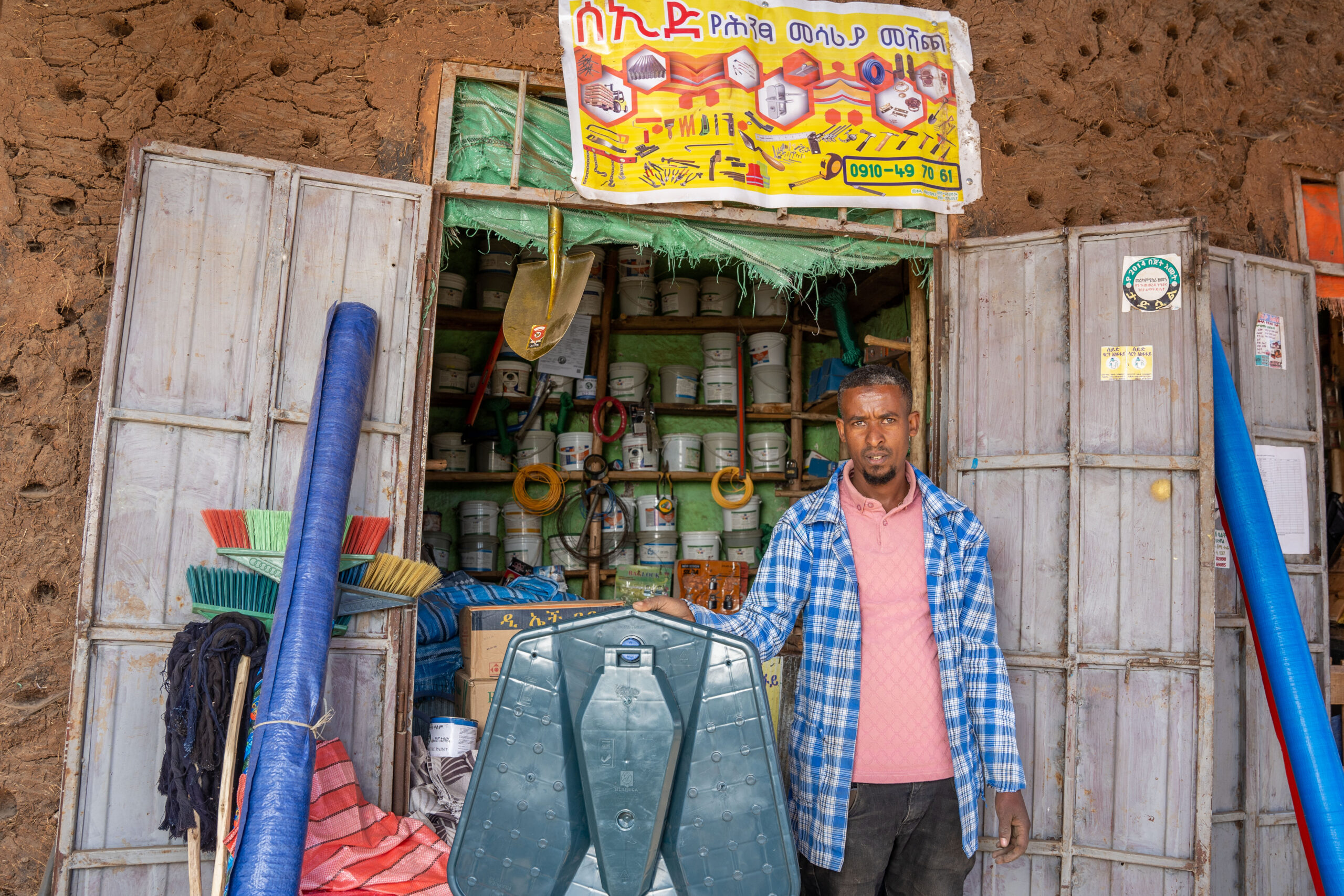
A sanitation entrepreneur displays latrine materials and tools at his shop. Sanitation advice only becomes achievable when the materials behind it are within reach.
The entrepreneurs already inside the child health system
Micro and small enterprises, agro-dealers, sanitation entrepreneurs and nutrition businesses already supply much of what families need to act on health advice. They produce or sell fortified flour, latrine slabs, reusable sanitary pads, improved stoves, handwashing facilities and agricultural inputs. These are not only commercial products. They are the practical means by which families improve nutrition, hygiene and sanitation at home.
Entrepreneurs living in the communities they serve tend to understand the preferences, constraints and purchasing realities around them. In rural and fragile settings, where formal supply chains are weak or absent, they offer flexible and locally adapted solutions.
Many of these enterprises are led by women. That creates opportunities not only for access to products, but for income, confidence and recognition. It also means the barriers women face as business actors — unpaid care responsibilities, limited mobility, lack of collateral, and not being seen as entrepreneurs by finance providers or government offices — become barriers to child health too.
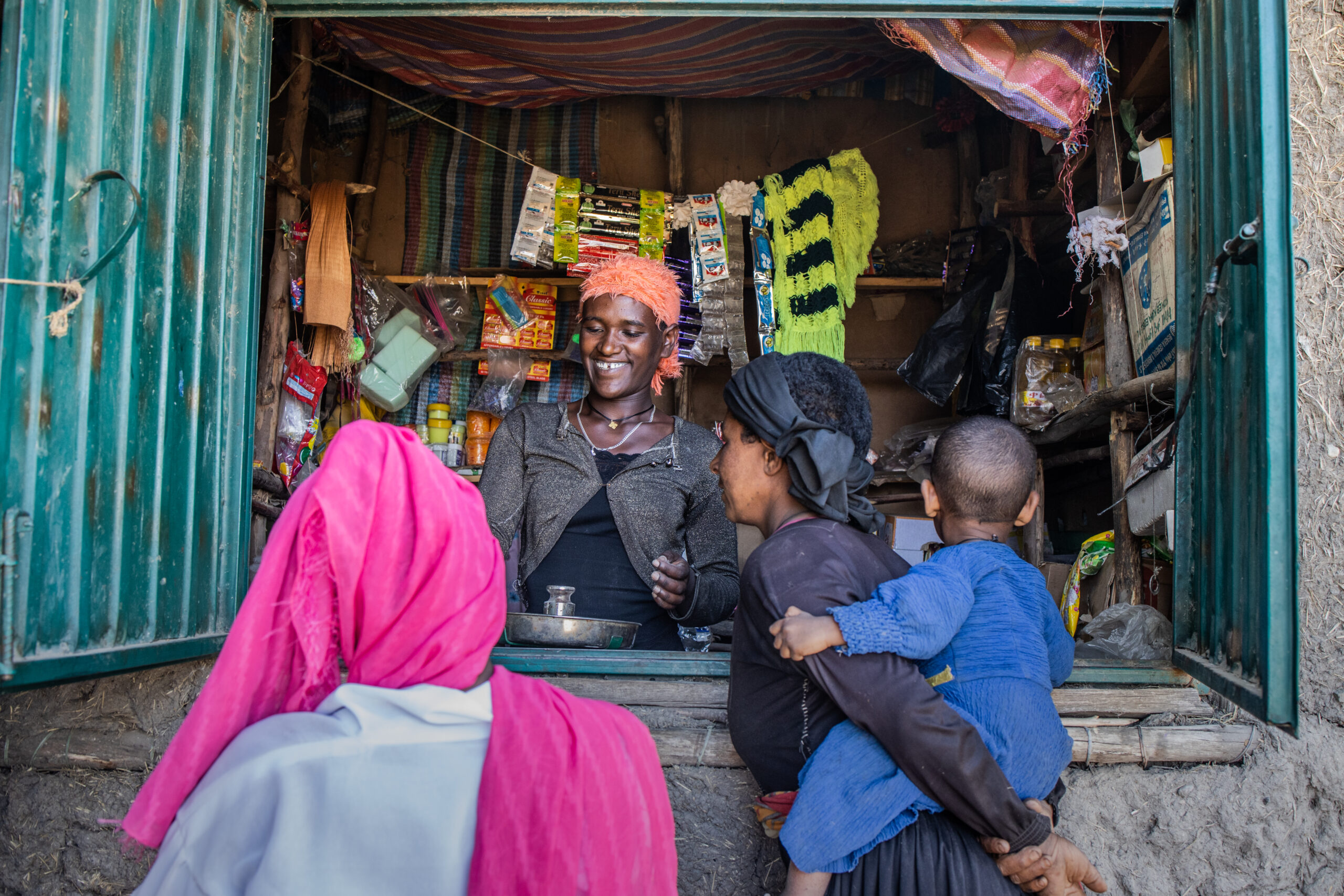
A shopkeeper sells nutritious porridge flour (Mittin) to families in her community. Products like these are how nutrition advice becomes something a household can act on.
Field story · Asefu Gesesew, Tigray
Asefu produces and sells Mittin, a nutritious porridge flour made from locally available cereals and legumes. When customers have no cash, she trades instead — a kilo of Mittin for two kilos of wheat.
Selling Mittin has lifted Asefu out of poverty. It has given her a livelihood, improved her family's diet, and eased the strain of living on an unpredictable income. She is confident she could repay a loan and expand. She does not have the collateral to get one.
What we tried
Within the Healthy Village programme, we worked with entrepreneurs through training, direct engagement, and links with community structures such as Village Economic and Social Association (VESA) groups. This made the role of local market actors visible inside a programme built around child health, WASH and nutrition.
VESA groups are a useful entry point. They support savings habits, peer learning, trust and small loans, and they connect entrepreneurs to the households and platforms where nutrition and hygiene behaviours are already being discussed.
They are not, on their own, enough. Wider evidence on savings groups points the same way: they support household stability and small-scale economic activity, but rarely enterprise growth. Entrepreneurs who want to expand need larger and more reliable capital, dependable inputs, equipment, workspace, transport, clear quality standards and stronger market linkages. Training and group membership do not supply those.
The constraint is rarely the entrepreneur
This is the central learning from our work in Amhara and Tigray. An entrepreneur may have motivation, ideas, community trust and the right skills, and still stall — because finance is unavailable, inputs are too expensive, transport is unreliable, quality standards are unclear, demand is weak, or licensing and taxation are difficult to navigate.
A market system lens makes this visible. The entrepreneur sits at the centre. Around them is a layer of support actors — finance providers, training institutes, input suppliers, transporters, cooperatives, extension services. Around that sits the enabling environment: rules, standards, licensing, taxation and the coordination that holds it together.
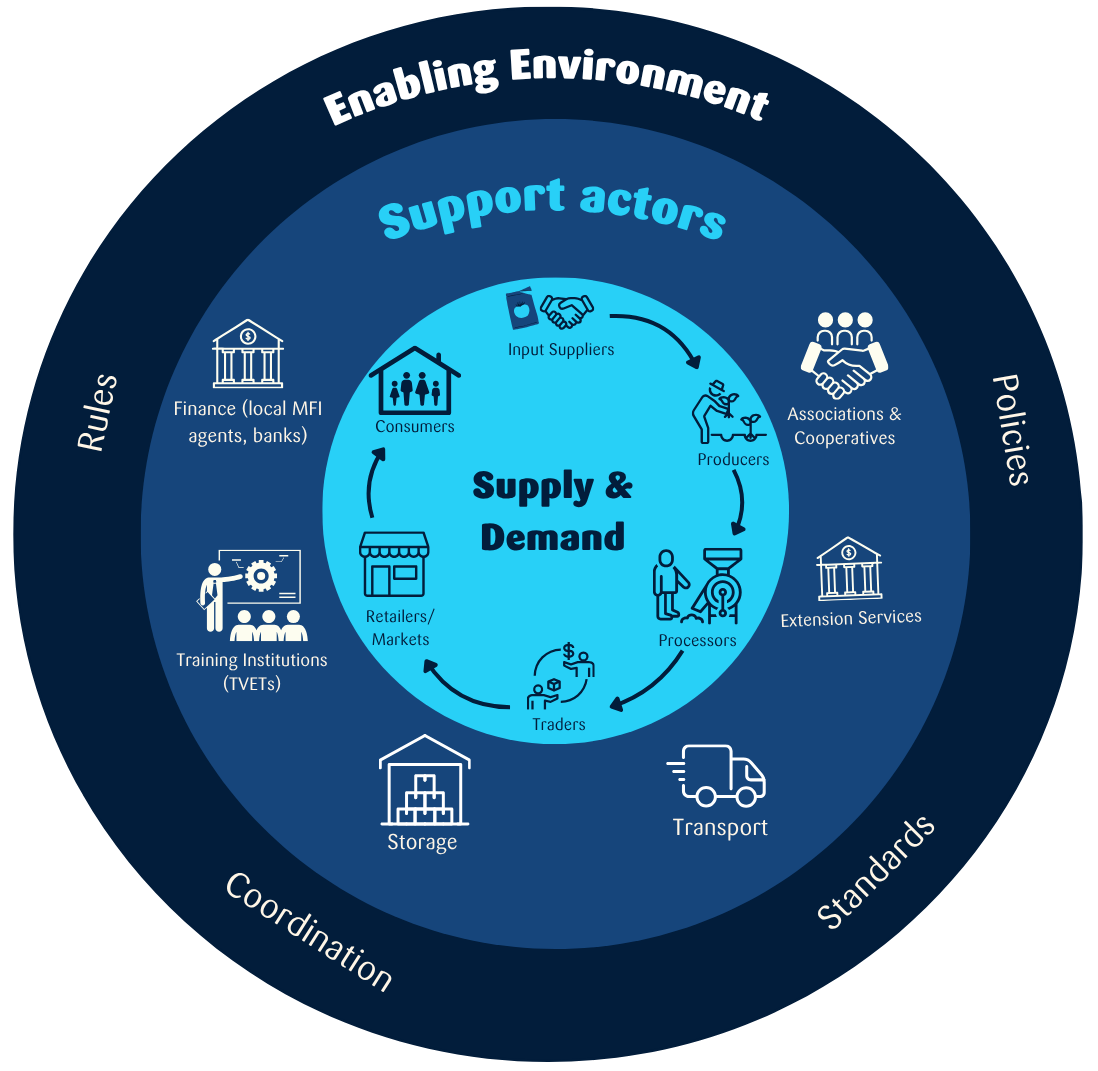
A market system development lens: entrepreneurs at the centre, surrounded by support actors and the wider enabling environment.
In our experience, both outer layers are underperforming. Working capital is one of the primary constraints entrepreneurs report, yet banks have limited presence in conflict-affected regions such as Amhara and Tigray because of the risks of operating there. Technical and vocational education and training (TVET) institutes offer courses that are not always linked to real market opportunities. Input suppliers can be unreliable or expensive. Extension services and cooperatives do not yet consistently see entrepreneurs as part of the WASH and nutrition system at all.
The enabling environment is not yet supportive either. In Tigray, engagement by local government bodies is minimal, extending in practice to allowing entrepreneurs to operate unlicensed. Government actors may recognise the importance of WASH and nutrition behaviours without yet seeing the private sector as part of what allows households to practise them.
Frehiwet Redae · Tigray
No adequate workspace and no reliable electricity are what stand between Frehiwet and a larger operation. She adapts anyway — sealing her products by candlelight during power cuts.
Lamesgen Mekuriaw · Amhara
An agro-dealer distributing animal feed and day-old chicks. Growing his business moved him into a higher taxpayer bracket, bringing complex legal duties and little corresponding support from government.
When conflict reaches the market
In fragile and conflict-affected areas, local entrepreneurs matter more and operate under harder conditions. Conflict disrupts transport routes, damages infrastructure, reduces household purchasing power, and cuts off access to raw materials, equipment and finance.
They are also among the first to help restore access to essential goods when formal supply chains fail. In some areas, women take on stronger provider roles as men are displaced or migrate for work. Semaynesh, in Amhara, lost customers because she can no longer travel to source the inputs she needs to produce Mittin. She sustains her income by trading fruit and vegetables and joining savings groups as a financial backstop.
This shows both the potential and the exposure of local entrepreneurship. Entrepreneurs can hold access open when other systems buckle, but they cannot carry that role alone. In fragile settings especially, they need stronger links to finance, inputs, transport, quality assurance, public institutions and community platforms. For WASH and nutrition programming, that means treating local markets as part of how a system withstands shocks — not as an add-on to it.
The question becomes
How can government, finance institutions, training providers, input suppliers, extension services, cooperatives, NGOs and community platforms work together, so that local entrepreneurs become reliable suppliers of WASH and nutrition products and services?
What this means for government and NGOs
Government
Creates awareness and demand through health workers, schools and community platforms — and, on the supply side, coordinates actors, simplifies policies and procedures, assures quality, and includes entrepreneurs in local planning.
NGOs
Move beyond supporting individual businesses and work as market system facilitators — connecting entrepreneurs with finance providers, TVETs, input suppliers, cooperatives, government offices and community structures, while identifying where the system is not yet functioning.
This does not mean commercialising child health. It means recognising that many essential WASH and nutrition products already move through local markets — and that those markets need to work better for families with low incomes.