From Weighing Children to Understanding Growth
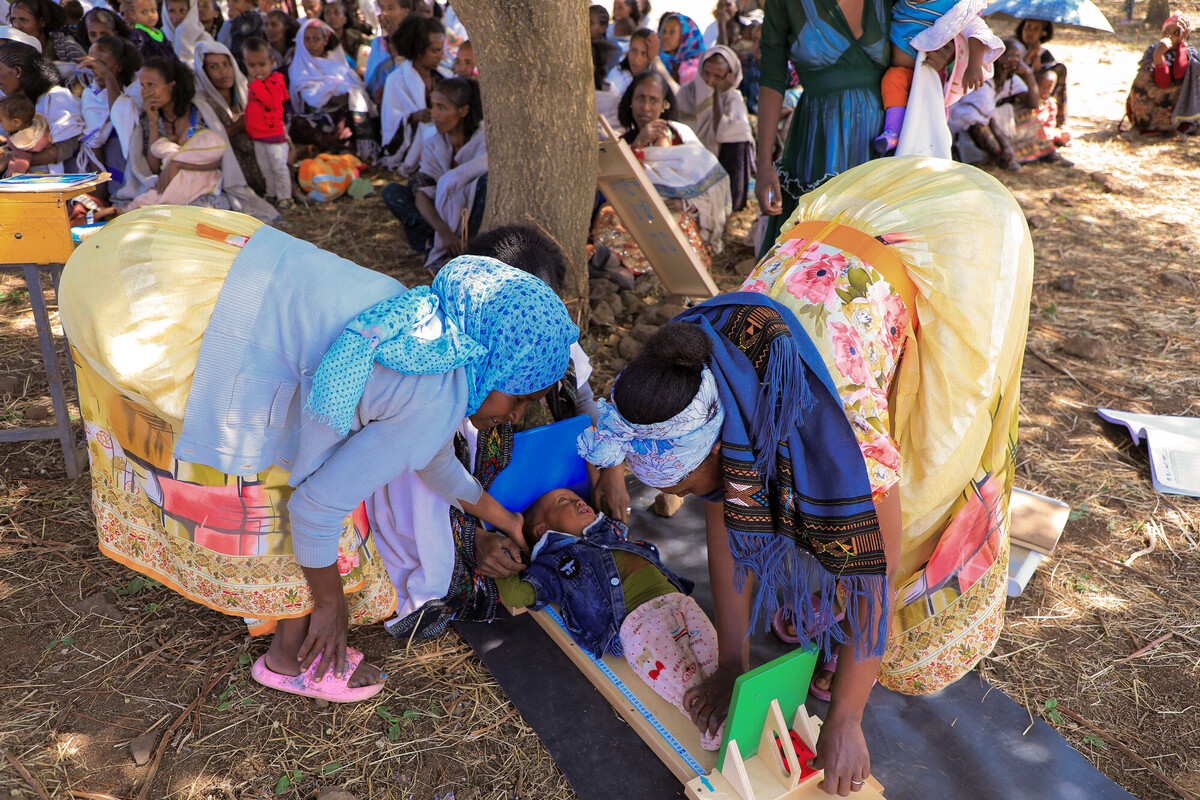
Health Extension Workers measure a child's length during a community growth monitoring session.
A child can sit at an acceptable weight and still be growing too short for their age. Weight alone will not show it. That gap is why the Healthy Village Programme added length measurement to routine growth monitoring in Ethiopia — and why the question now facing the country is not whether to scale this work, but how to scale it without losing what makes it work.
Growth Monitoring and Promotion (GMP) is one of the few moments when a health worker, a caregiver and a young child are in the same place, with a measurement in hand and a reason to talk about feeding, hygiene and care. In Ethiopia it carries particular weight: the Seqota Declaration commits the country to ending stunting among children under two.
But routine GMP for children under two has largely meant weighing. Weight shows whether a child is underweight or under acute nutritional stress. It does not show stunting, which develops gradually, reflects chronic undernutrition and repeated exposure to poor health, feeding, care and sanitation conditions — and which caregivers often cannot see at all. So the programme introduced length measurement alongside weighing, counselling and follow-up. It has since been taken up as an innovation to be scaled within the national model for scale-up of the Seqota Declaration.
The findings here come from qualitative research commissioned under the Healthy Village Programme and conducted by Node Consult P.L.C. in four districts: Emba Alaje in Tigray, and Goncha Siso Enese, Enebse Sarmidir and Shebel Berenta in Amhara.
 Credit: Genaye Eshetu
A Health Extension Worker checks a child's mid-upper arm circumference at home — part of the fuller growth assessment introduced under the programme.
The question for national scale-up
Is GMP ready for scale — and what is needed to scale it well?
What changed in practice
Health Extension Workers were trained and supported to carry out a fuller assessment: weight, length, mid-upper arm circumference (MUAC), interpretation of growth status, counselling and follow-up. Health posts received scales, length boards, growth charts and registration books, and in some areas digital tools. Sessions were connected to cooking demonstrations, hygiene sessions, home visits and mother-to-mother support groups.
The effect was to turn a measurement into a conversation. When a child is not growing well, a Health Extension Worker can raise breastfeeding, complementary feeding, recent illness, hygiene, sanitation and referral — at the moment a caregiver has a reason to listen.
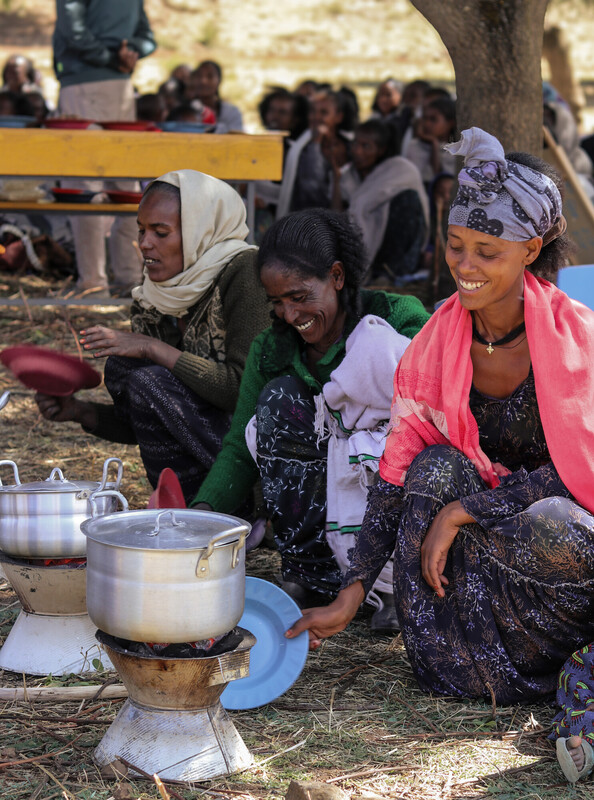
A cooking demonstration reinforces the feeding advice given during GMP sessions.
 Credit: Genaye Eshetu
A Health Extension Worker records information during a home visit.
Caregivers gained confidence and improved feeding and hygiene practices. In some households, families began keeping eggs, milk and vegetables for their children rather than selling them. The research also found that measuring children was, in some communities, initially surrounded by fear or misunderstanding, and that some caregivers associated taking part with receiving material support. Counselling and the involvement of community and religious leaders reduced those barriers — but they had to be worked at.
Ready for scale — with conditions
The experience suggests GMP is ready to be scaled as an approach, provided there is investment in the system around it. Every health post and outreach setting has to be able to measure accurately, read the result correctly, and act on it. Five things could limit that.
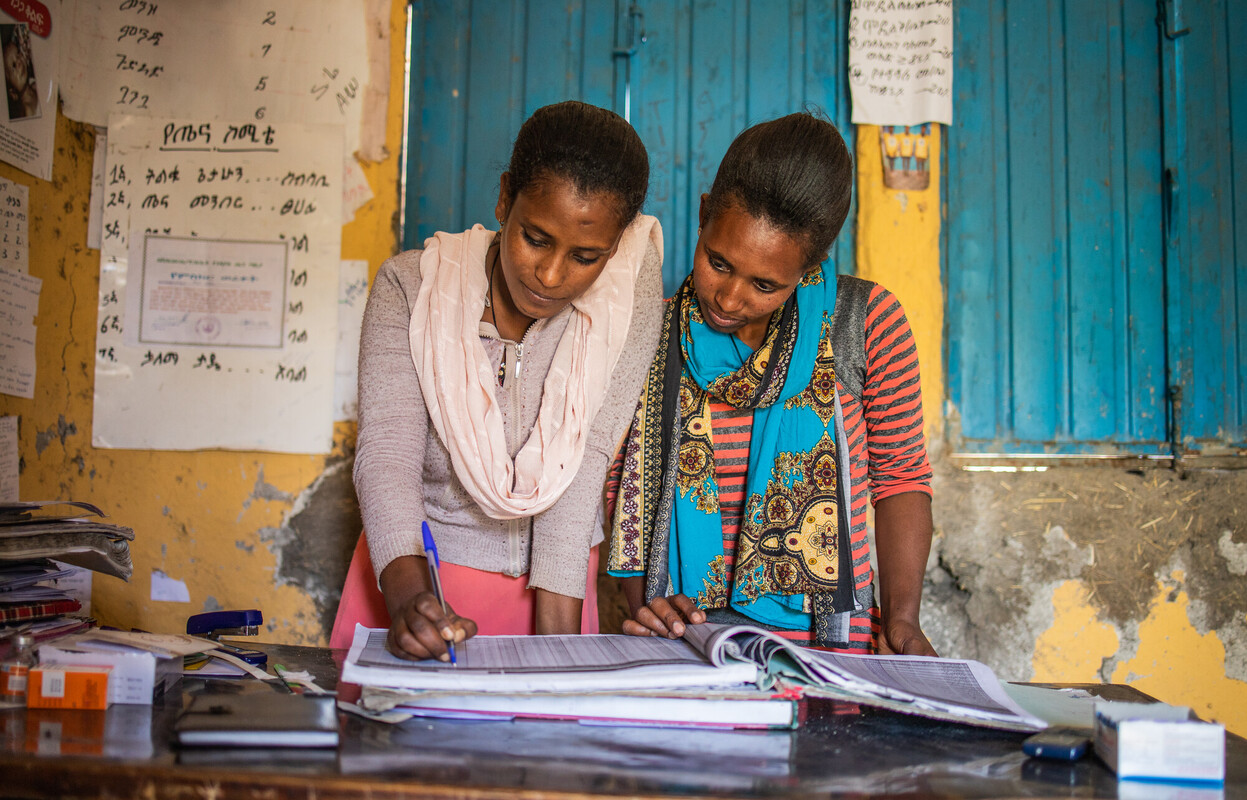 Credit: Genaye Eshetu
Health Extension Workers review growth monitoring records at their health post.
Workload
Health Extension Workers already run health post services, household visits, school health activities, campaigns and reporting. Length measurement and counselling improve quality — and take time. If workload is not planned realistically, GMP is reduced to measurement without the promotion.
Equipment
Length measurement needs proper equipment and good technique. Measure a child badly and the data misleads — and the counselling built on it misleads with it.
Access
Distance, difficult terrain, insecurity, disability-related barriers and household responsibilities all make regular attendance hard. Scaled only through fixed health post sessions, GMP will keep missing the families it most needs to reach. Outreach will be needed, particularly in remote kebeles.
Infrastructure
Sessions ask mothers to wait, children to be undressed and counselling to happen respectfully. Health posts short of waiting space, water, sanitation facilities or privacy make that harder.
Sustained behaviour change
Economic hardship, food availability, gender norms and competing priorities all shape whether a caregiver can act on advice. GMP has to stay connected to household support, water and sanitation, and food and nutrition security.
The question is not whether GMP should be scaled. It should. The question is how to scale it without losing quality.
Five things scale-up needs
1. Treat length measurement as standard, not an add-on. That means clear national guidance, practical job aids, and integration into routine monitoring systems — so health workers know why length matters, how to measure it, and how to explain the result to a caregiver.
2. Equip health posts and outreach teams properly. At national scale, equipment cost and availability could become a major bottleneck. The answer is not only procuring more, but finding cheaper and shorter routes to supply.
Local innovation
Length boards made by woodmakers in Ethiopia
Under the Healthy Village Programme, woodmakers have piloted producing length boards themselves — shortening the supply chain, cutting cost and keeping the income close to where the boards are used. Quality standards decide whether it holds up: locally made tools must be accurate, durable, safe and aligned with national specifications.
⅓
of the cost of length boards bought in Addis Ababa

A woodmaker with a length board he makes and sells.
3. Support Health Extension Workers — and plan their workload honestly. Measuring length is more demanding than weighing, and reading growth status takes confidence, so training, mentoring and supervision matter. It also means accepting that Health Extension Workers cannot carry GMP alone. Which parts can community structures safely take on without quality slipping? The programme is testing that now, with mother-to-mother groups and village health leaders.
4. Keep promotion at the centre. The promotion half of Growth Monitoring and Promotion is what turns a measurement into a change at home. Caregivers need to know what the numbers mean and what they can do next, in terms connected to their own household.
5. Design for inclusion from the start. Caregivers in remote areas, mothers with disabilities, single mothers, households with less income and communities affected by insecurity may need outreach sessions, mobile teams or community-based follow-up. If GMP is meant to contribute to national stunting reduction, it has to reach the children most likely to be missed.
Where we stand
Length measurement is now part of the national model for scaling the Seqota Declaration. That is the outcome that matters most, and it did not come from Max Foundation running growth monitoring sessions. It came from Health Extension Workers, health posts, district health offices and the Ministry of Health testing something and finding it worth keeping.
Several questions underneath it are still open. How much community structures can take on without quality slipping is being tested, not answered. Whether locally made length boards hold national specifications at scale is unproven. And a measurement only counts for something if a caregiver can act on what it shows — which depends on food, water, income and time, none of which a health post controls.
GMP is not effective simply because it exists. It becomes effective when health workers have the time, tools, skills and support to use it well. That is the part scale-up has to fund.