Growing more with less: A hydroponics pilot

Lettuce in hydroponic channels with oat fodder trays between them, Woramit Horticulture Research and Training Station.
Growing vegetables without soil sounds like the wrong technology for rural Ethiopia. A pilot at Woramit in 2025 tested it anyway — not to prove hydroponics works, which is well established, but to find out whether it can be built from local materials, fed with cow dung and vermicompost rather than imported nutrient salts, and kept running by people who live nearby.
The pressure behind the question is straightforward. In many areas of Ethiopia, seasonal rainfall, limited irrigation access, poor soils and climate-related shocks make it hard for families to produce diverse and nutritious food across the whole year. Hydroponics grows plants in water and nutrient solution instead of soil, and because both can be reused within the system, it uses less water and depends less on soil quality.
The question behind the pilot
Can communities produce more nutritious food using fewer natural resources?
The pilot ran at the Woramit Horticulture Research and Training Station in Amhara, testing two crops — lettuce for people, oat fodder for animals. It examined the physical structure as well as the growing: frames, germination trays, transplant cups and vessel boxes built from fibre materials chosen for durability and easy maintenance, covered with plastic and netting against rain, wind and temperature swings.

1. Seeds are started in germination trays.

2. Seedlings move into net transplant cups.
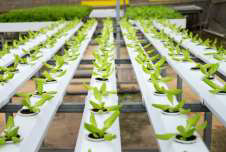
3. Cups sit in channels fed by nutrient solution.
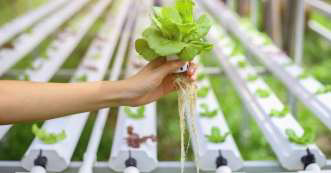
4. Roots grow in water, without soil.
Fourteen farmers and professionals were trained, including staff from the Organisation for Rehabilitation and Development in Amhara (ORDA) and the district agricultural office. Training covered nutrient preparation, seedling management, system operation, plant health monitoring and efficient use of water and nutrients, with hands-on demonstrations throughout.
The nutrient question was the heart of it. Most hydroponic systems run on commercial nutrient solutions that are expensive or simply unavailable to smallholder farmers. So the pilot tested six alternatives instead: vermicompost tea, cow dung tea, chicken manure tea, liquid organic fertiliser, artificial fertiliser, and combinations of these.
What the pilot showed
Hydroponic production using locally available nutrient sources is technically possible. For lettuce, vermicompost tea outperformed every other solution tested — on plant height, leaf length, leaf width, root biomass and leaf yield. Cow dung tea did reasonably well too, particularly for root growth.
Best performer
Vermicompost tea, on lettuce
Worm-composted organic waste, steeped in water. It can be produced locally, given the right inputs, skills and quality control — which is what makes the result interesting beyond the trial itself.
The oat fodder trial also grew well and looks potentially relevant for urban and peri-urban areas. But it is too early to recommend it for livestock feeding: the nutritional quality and chemical composition of the fodder still need analysis, as does the cost-benefit against other feeding options.

Oat fodder grown in trays for animal feed.

A fodder mat lifted to show the root layer beneath — grown in days, without soil.
The finding with the longest reach was not agronomic. A youth enterprise handled the design, fabrication, installation, training, maintenance and monitoring of the systems. Hydroponics is unlikely to spread through one-off training — it needs ongoing technical support and someone nearby who can fix things when they go wrong.
What makes it promising
Less dependence on soil. Relevant where soil quality is poor, land is limited or soil-borne diseases affect production — and potentially suited to schools, youth groups, demonstration sites and households with little growing space.
More efficient water use. Compared with soil-based production, which matters for areas facing water scarcity or unreliable rainfall. This still needs testing under real conditions, including actual water availability and quality.
Lower input costs. Local nutrient sources could reduce dependence on imported or commercial solutions, which is precisely why the vermicompost result matters.
Waste as an input. Cow dung and chicken manure become productive material rather than a disposal problem, linking agriculture to environmental health. Safe preparation, hygiene and consistency of nutrient content all need more attention first.
Opportunity beyond the food itself. Construction, installation, repair, training, input supply and follow-up are all work. That makes hydroponics a possible local business model, not only a production technology.
What the pilot does not show
It does not show that hydroponics is ready for wide-scale household adoption. Five practical questions are still open.
Management intensity
Nutrient solutions need careful preparation, water levels need checking, plant health needs watching. Miss a few days and growth suffers quickly. This is a demanding system, not a set-and-forget one.
Accurate measurement
Plants need the right pH and electrical conductivity, which means instruments, skills and the confidence to use them. Mixed wrong or left unmonitored, yields fall.
Variation in nutrient quality
Vermicompost, cow dung and chicken manure teas vary with raw materials, preparation method, storage time and dilution. The advantage of local nutrients disappears if farmers cannot get consistent results — which means simple, locally tested preparation protocols are needed.
Cost and labour
The pilot demonstrated technical potential, not economic sense. Structure, inputs, labour, water, maintenance and replacement parts all have to be weighed against the value of what is produced. That work has not been done.
Nutrition relevance
Lettuce grows well hydroponically. It is not the strongest crop nutritionally. To matter for nutrition outcomes, future testing needs crops that are both feasible in these systems and relevant to actual dietary gaps — leafy greens rich in micronutrients, for instance.
What this means for scale
Hydroponics can work under local conditions when the structure is adapted, nutrient solutions are carefully prepared and technical support is available. All three conditions matter.
It may not be right for every household. A more realistic reading is that it suits particular users — motivated farmers, youth enterprises, schools, farmer training centres, urban and peri-urban producers, demonstration sites connected to nutrition-sensitive agriculture. These are the settings with the attention to manage a system daily and somewhere to send the produce: markets, school meals, livestock feeding or community learning.
A scale model would need considerably more than equipment: training and follow-up support, access to pH and electrical conductivity meters, clear nutrient preparation guidance, reliable input supply, and enterprises that can build and maintain the systems. It would also need evidence on costs, labour, yields, crop quality and whether people actually want it.
Youth enterprises may be the deciding factor. If they can fabricate affordable systems, provide technical support and build a viable business around installation and maintenance, they become the scale pathway. That business model has not been tested yet.
Where we stand
This was a pilot at a research station, not a programme result. It answered the first question — can this be built and fed locally — and it answered it well enough to justify the next one, which is harder: does it pay, and can anyone other than a trained team keep it running?
We would rather publish that honestly than present a promising trial as a solution. The value of a pilot is that it tells you which problem to work on next.