Safe water Market Systems: what it takes to make it work
Safe water in rural Bangladesh isn’t only an access problem. It’s also a market design problem. Here’s how Max TapWater is solving it through a commercially viable social enterprise model.
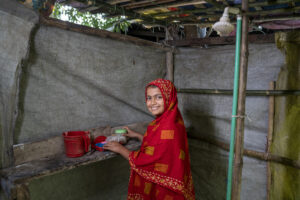
Only 5% of rural households in Bangladesh have access to piped water. The other 95% rely on tube wells, ponds, or boreholes — sources often contaminated with arsenic, iron, or salinity. Households spend up to BDT 2,000 (€14) per month treating water-related illnesses. Non-piped water, when accounting for vendor fees, containers, and health costs, runs 3 to 10 times more expensive than piped supply. The problem is not that safe water is unaffordable. It is that the market to deliver it does not yet exist at scale.
Max TapWater is building that market. Since 2019, it has constructed and operated 100 decentralised piped water mini-grids across four districts in the Barisal and Khulna regions of southern Bangladesh, serving over 22,000 people in more than 5,000 households. Each grid connects 50–100 rural households to an overhead tank fed by a borehole, providing 24/7 safe water supply — approximately 80 litres per person per day — piped directly into the home.
A social enterprise, not a programme
Max TapWater operates as a commercially registered social enterprise under Max Social Enterprise Ltd. (MSE), a Bangladeshi-registered company. This is a deliberate structural choice. Unlike a time-bound project that stops when donor funding ends, a commercially operated water service has an inherent incentive to keep running: if the service stops, the business stops. Each grid generates its own revenue through a metered, pay-per-use tariff system, averaging BDT 276 (€2) per household per month — significantly less than what households currently spend on water vendors or illness treatment. Connection fees of BDT 5,000 (€35) are covered by loans from microfinance institutions including ASA, BRAC, and PKSF for households who cannot pay upfront.
Central to the model is the network of local grid operators — one trained entrepreneur per grid — responsible for daily operations, tariff collection, minor maintenance, and customer engagement. They receive a salary and a performance-based incentive linked to collection rates. Around them, a broader ecosystem of Health Promotion Agents, sanitation entrepreneurs, plumbers, and sweepers generates demand for piped water connections and complementary WASH services. This is how local economic activity and public health outcomes reinforce each other.
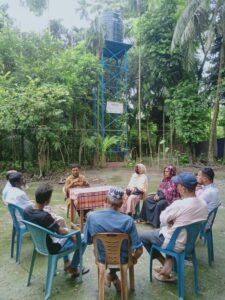 Demand Creation Session
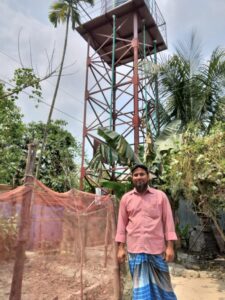 Entrepreneur standing in front of Water Tower
Results-based financing: paying for what works
One of the most distinctive features of Max TapWater’s funding model is its use of results-based financing (RBF). Under this approach, grants and donor subsidies are disbursed only upon verified delivery of results — specifically, operational water grids with active, paying household connections. Funders pay for grids that are working, not for plans or construction in progress.
RBF is rare in the WASH sector, where most programming is funded on activities and outputs. By subsidising capital construction costs through RBF, Max TapWater can demonstrate operational viability and generate the tariff revenues needed to eventually attract private investment without ongoing grant dependency. The Generation TapWater project, funded by Aqua for All and the Dutch Embassy, has applied this model since 2021, with results independently verified on a quarterly basis.
What’s Next
By end of 2026, Max TapWater aims to operate 130 grids, with 120 upgraded to smart grids integrating digital metering, automated operations, real-time monitoring, and mobile payment through bKash. Smart grid upgrades reduce water losses, improve service reliability, and strengthen the financial case for private capital — moving the enterprise from subsidised construction through operational maturity toward commercial expansion. Communities served have already seen a 40% reduction in reported waterborne diseases. The ambition is a Bangladesh where safe water reaches every rural household through an expanding network of locally operated, commercially viable smart water grids.
Max TapWater operates under Max Social Enterprise Ltd. (MSE) in partnership with Max Foundation. The Building Water Business (BWB) programme is supported by Aqua for All, the Embassy of the Kingdom of the Netherlands, and Stone Family Foundation.
Visit the Max TapWater website for more information.