Rethinking Cost-Effectiveness
From Funding "What Works" to Funding "What Lasts"
Budgets are tighter, uncertainty is rising, and the demand for measurable results has never been higher. In that context, cost-effectiveness has become the dominant lens: how many people can we reach per euro, and how cheaply can we do it?
The instinct to maximise value for money is understandable. It is also limiting. Unit costs and short-term outcomes obscure the deeper question — what remains when the funding ends? The answer lies not in funding what works, but in funding what lasts: solutions that governments, health workers, entrepreneurs and households can adopt, adapt and scale on their own.
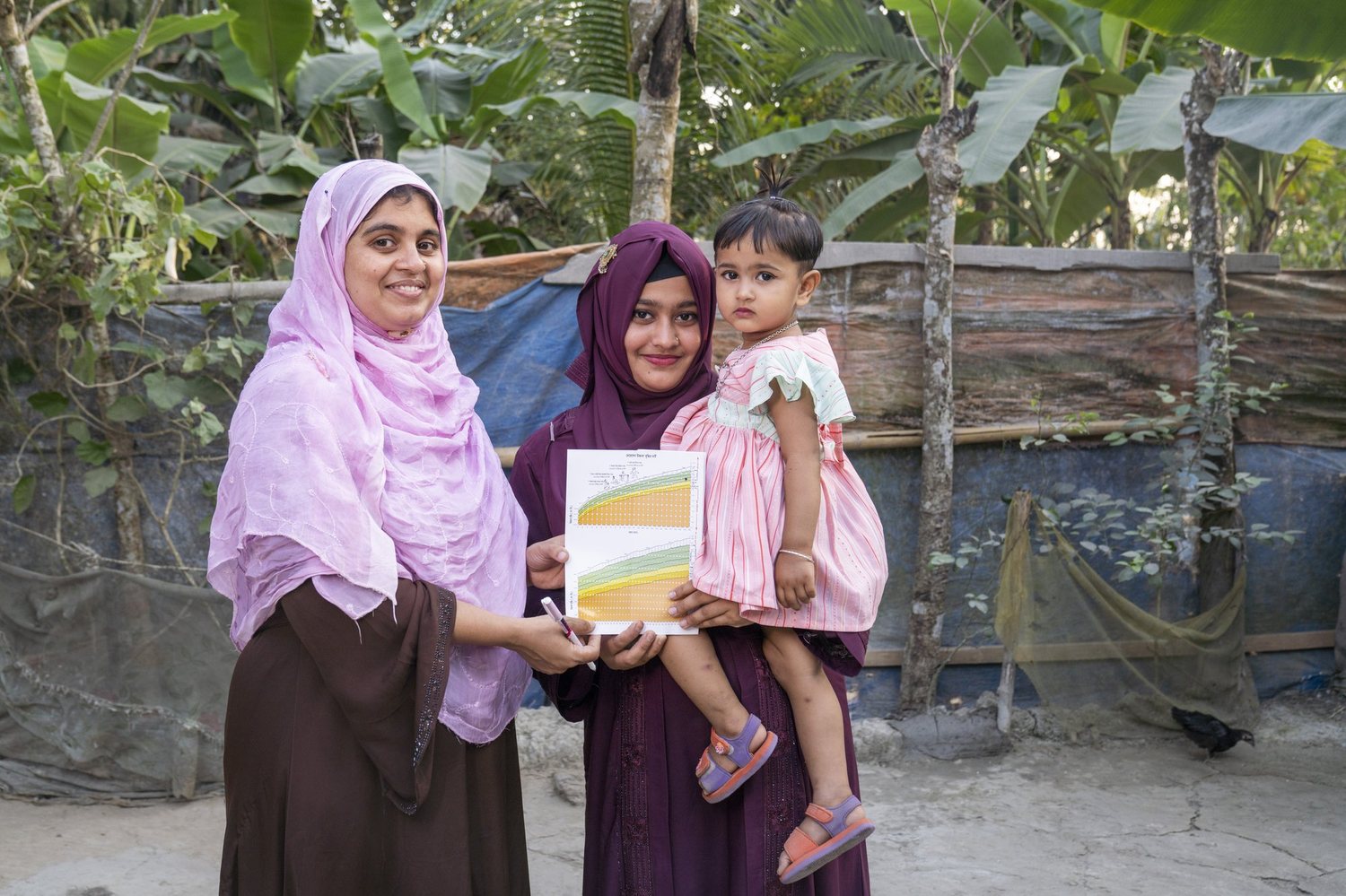
A health worker reviews a child's growth chart with her mother in Bangladesh. Routine, repeated, unspectacular work is what most system change actually consists of.
Why the conventional view falls short
Traditional cost-effectiveness frameworks reward visible, short-term results. Cost per child reached. Cost per clinic supported. Cost per household served. These numbers are easy to compare, and they rarely capture whether a solution endures.
The problem is not the intent — donors are right to demand accountability and value for money. The problem is the scope. When effectiveness is defined narrowly, it keeps the implementer at the centre and sidelines the actors who actually sustain change.
Solutions designed for pilots are not designed for permanence. They risk collapsing the moment donor support is withdrawn.
From uptake to scale: the pathway funders need to see
Funding what lasts means looking past the direct intervention to the network of actors who would need to carry it, and the relationships between them. A solution that creates system change travels through four steps — though rarely in a neat, linear order. In practice these steps overlap, loop back on themselves, and scaling and replication are less a fixed sequence than a choice, depending on where a solution can travel next.
01
Uptake
A local actor is curious enough to test a new idea.
02
Adoption
It is embedded into routine practice, policy or structure.
03
Scaling
Uptake becomes wide enough to alter the system itself.
04
Replication
Other actors carry the model into entirely new settings.
This pathway is messy and time-intensive by nature, and it is consistently the least-funded stage of the process — donors fund testing readily, but rarely the harder, slower work of transition to scale. Reading a solution against this pathway reframes the cost question. The cheapest option may fail to scale if local systems cannot integrate it. A slightly more expensive one with strong uptake potential can return far more over time.
What this looks like when it works
In 2020 we began implementing the Healthy Village Programme with Plan International across four woredas in Amhara and Tigray, as a partner to Ethiopia's Seqota Declaration. It was deliberately structured not as a parallel delivery system, but as a way to test integrated interventions, generate evidence, and share what we learned with government at every level — from village health posts to the federal Ministry of Health.
In 2025, the Ministry of Health's Seqota Declaration team and Max Foundation drew the lessons from both sides together into the Malnutrition-Free Healthy Village model: a single national framework, and the primary vehicle for the Seqota Declaration's 2026–2030 scale-up across more than 1,000 woredas. Alongside it, the digitised growth monitoring system we co-developed — which puts length measurement into the national e-CHIS platform — has been adopted by the Ministry for replication across five regions and 37 woredas.
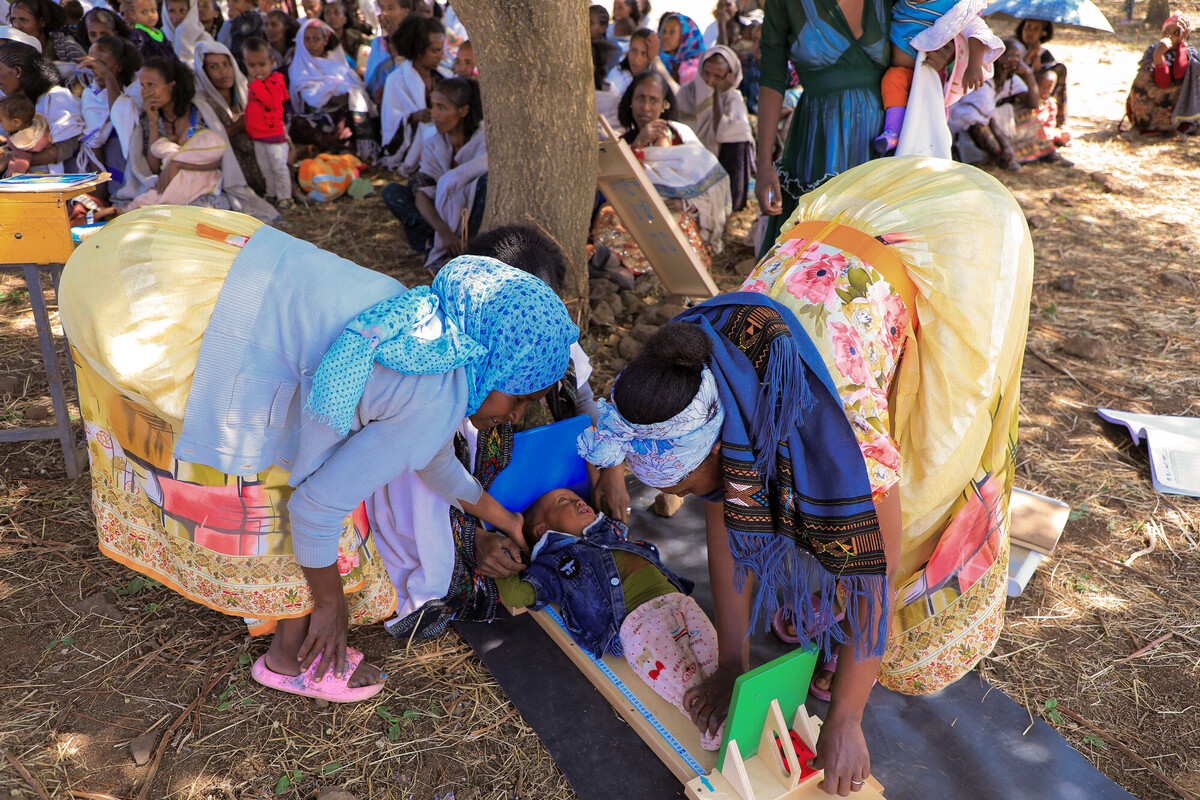
A child's length is measured at a health post in Ethiopia. This single measurement — the key indicator for detecting stunting — is what now travels into the national e-CHIS platform.
The pathway in practice
1,000+
woredas in the national scale-up the model now anchors
4
woredas where the approach was originally tested
5 yrs
of iteration between first pilot and national framework
Read how the Healthy Village approach became national guidance
We want to be honest about what this example is and is not. No organisation can promise a donor that a government will adopt its model. The path from four woredas to a national framework was long, messy and repeatedly redirected — through a conflict, through changing government priorities, through versions of the approach that did not survive contact with reality. It required adapting far more than we had planned to adapt, and letting go of ownership of the thing we had built.
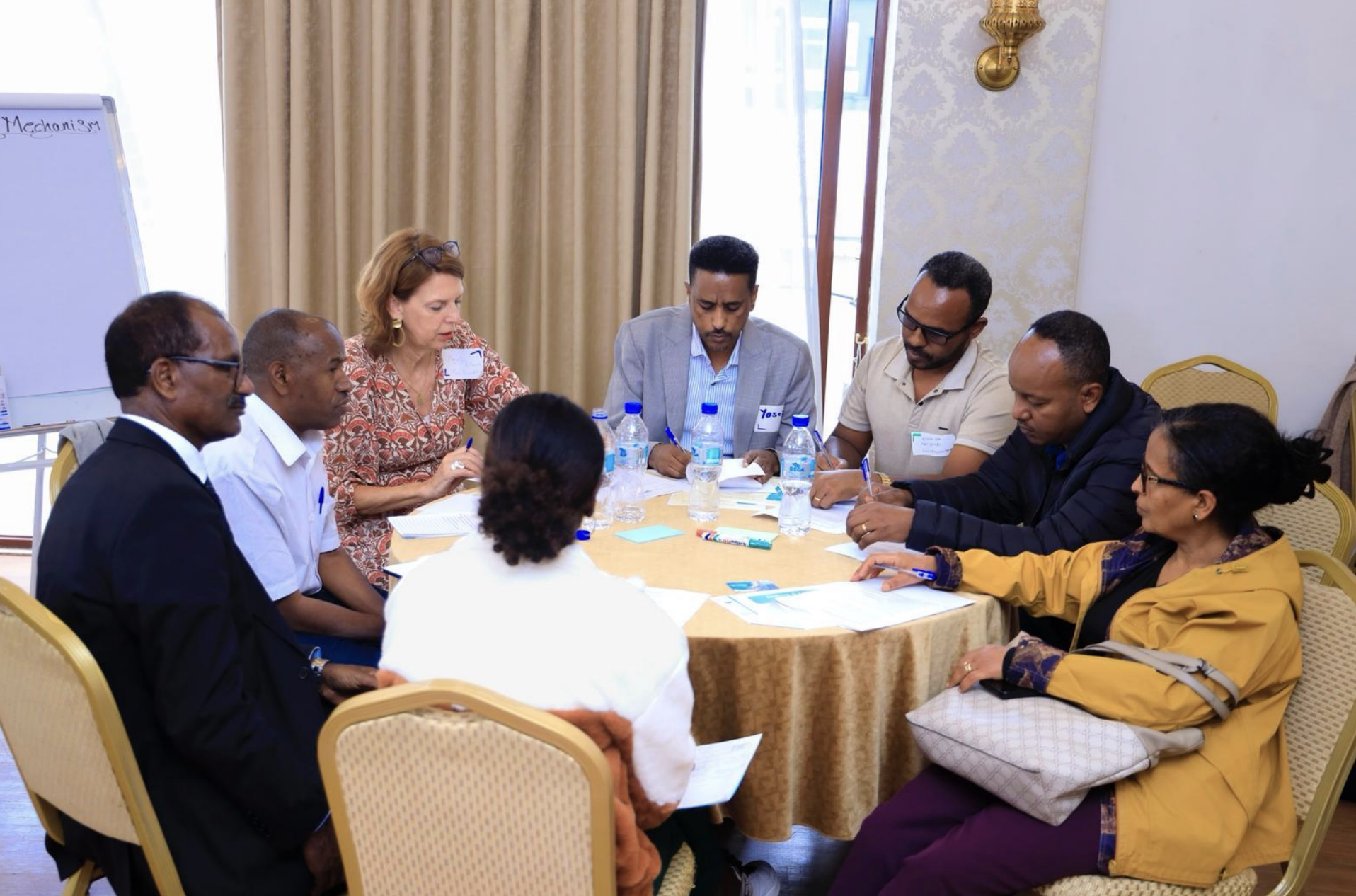
Working through the Malnutrition-Free Healthy Village model with government and partner teams. Rooms like this one, not the pilot sites, are where a programme becomes national guidance.
What can be committed to is the design. Working through government systems rather than around them, generating evidence others can use, and building something a public institution could realistically take over — none of these guarantee the outcome, and all of them make it possible. A programme designed for permanence sometimes achieves it. A programme designed for a pilot never does.
Four concepts worth adding to the conversation
It is time to expand how value is defined and measured. These four ideas complement conventional cost-effectiveness rather than replacing it, and they better reflect what scaling an innovation inside a complex system actually demands.
Cost of local ownership
Rather than asking only what implementation costs a donor, ask what it costs local actors to sustain the model independently. A low initial cost can conceal high operating costs for local institutions, which makes scale unrealistic. Building parallel systems often looks more cost-effective during a programme's lifetime; embedding into existing systems is more effective long after it.
That makes co-design non-negotiable. The knowledge already exists locally — it needs to be surfaced, sharpened and de-risked so the solution is practical, acceptable and financially viable for the people who will run it.
Systemic leverage
Some models act as multipliers, unlocking financing, policy change or private sector involvement far beyond their own budget. Leverage thinking asks how existing infrastructure and systems can be used to scale faster. It also pushes towards modular design, where the strongest elements move ahead while others gather evidence. A modestly higher initial spend can be the more cost-effective choice. This is more than cost-sharing — it is using what already exists to accelerate impact.
Adaptive value over time
Rigid programmes do not scale. Solutions designed for iteration and local adaptation may cost more upfront and hold up far better over time. Start lean, strip out the nice-to-have, test, then refine alongside the people using it. Smaller solutions are also easier to evaluate, and that evidence flows back into the next iteration.
Return on influence (ROI2)
Not all impact is direct or easily counted. Some of the most powerful interventions shift norms, shape policy or change institutional behaviour. Unlike Social Return on Investment (SROI), which monetises social outcomes, ROI2 captures the catalytic effect: how an innovation unlocks system-level change or mobilises others to act.
A model integrated into national policy, replicated by others without incentives, or reshaping donor priorities demonstrates high ROI2. These are the interventions that do not only work — they spark change beyond themselves.
Systemic leverage in practice
Under Right2Grow in Bangladesh, Max Foundation and partners did not only deliver child health services — they worked with local government to help open a dedicated child health budget line. It is a small change to a budgeting process, not a service delivered directly. But it is a lever: government funding, once allocated to child health, continues to flow to those interventions long after the programme itself has ended. That is what systemic leverage looks like in practice — not a bigger cheque from Max Foundation, but a permanent shift in where existing government money goes.
Why this matters for donors and financers
The role of a financer is not only to fund interventions, but to fund solutions that survive without them. The real test of cost-effectiveness is not how cheaply an intervention runs during a pilot. It is whether local actors can continue, grow and replicate it without ongoing external subsidy.
If local actors cannot afford to own and operate a model, it was never scalable to begin with. Funding models should prioritise four things.
Cost-effectiveness over time — not cost per programme participant.
Value for money that includes institutional buy-in and long-term local viability.
Lean impact — iterate quickly, learn fast, scale what works.
Funding transitions — not just implementation, but embedding, scaling and replication.
Rethinking this together
This shift is strategic rather than technical. Aligning funding with the pathway from uptake to systemic scale unlocks the kind of change that outlasts the investment that started it.
The integration of the Healthy Village approach into national guidance is not a conclusion. It is the moment at which a strengthened system begins to carry the work forward on its own terms — and that, rather than the unit cost, is what we think value for money should mean.